Showing posts with label Volunteer. Show all posts

Wednesday, April 14, 2010

Week 9 - Preparing


Time in: 10am
Time out: 12pm

The Ranch has some 50+ citrus trees in addition to other fruit trees that are ready to be transplanted into the ground. Pictured above is an abundantly fruiting Semi-dwarf Improved Meyer Lemon that I picked immature fruits off of to help preserve its growing power for establishing roots.

I also helped to mulch some of the fruit trees I assisted in pruning last winter. They all look healthy and well..

Week 9 - Desmoncus chinantlensis Mart.


Time in: 8:25am
Time out: 9:25 am

"Mexico: Chiapas: Mun. Palengue ca. km 60-61, 1.3 mi S of turnoff to Agua Azul 1950'.
Rainforest with yucca lacondonica."

Collected by: J. Bauml, M. Kimnach & H. Sanchez-Mejorada 10 Feb 1981


(Detail of specimen)

Tuesday, April 6, 2010

Week 8 - Planting more seeds

Time out: 12:30pm

This week I planted several varieties of:
  • Marigolds
  • Sweet bell peppers
  • Chili peppers
  • Eggplants
  • Tomatoes
We then placed the flats in the hothouse with the several varieties of tomatoes from last week.

Tuesday, March 30, 2010

Week 7 - Planting tomato seeds/Internship

Time in: 10am
Time out: 11:35am

It's that time again to get ready for the spring and summer seasons. Today, I helped plant a large variety of tomatoes, from cherry orange ones to bi-color beefsteaks, all in flats that are labeled, dated and sent to the hothouse to germinate and sprout.

One interesting thing I didn't know about tomato seed coats: at least most of those I planted are hairy (or pubescent). This increases its surface to volume ratio for water imbibition and uptake.

Personally, I think tomato seeds are one of the most beautiful seeds I've ever seen!

On another note, I was offered an internship position at the Ranch! I will start this new position in a couple weeks. I will be working 2 full days a week until November (date is approximate). This will be a great and valuable experience, one that I'm very honored to have and very excited about.

More details to come! ...

Week 7 - Chamaedorea tepejilote Liebm. ex Mart.


Time in: 8:45am
Time out: 10am

Location collected: Belize, Toledo District, Maya Mtns., Abraham Camp

Male; to 20'. Multiple stems, 3-6. Leaf rib with creamy stripe. 5 fronds. Male flowers musty green. Anthers cream.


Term of the Week

Anthers: The part of the flower, on the stamen, that contains pollen. (Source)

Tuesday, March 16, 2010

Week 5 - Food Forest


Time in: 10am
Time out: 11:15

Today I worked on adding a tray of Giant Goosefoot to the Food Forest in hopes that it will perpetually reseed itself for winter harvests to come. The Food Forest is the Ranch's large wild vegetable garden that stretches a number of acres. Patches of cleared and mulched land are dotted amidst sloping ground covered in oxalis. I planted them near the newly pruned fig trees, passed another large framed tree and stopped at a small grove of Guava trees, trying to be careful not to accidentally plant my foot or bucket of fertilizer down on a head of lettuce (believe me, its harder than it sounds)!

Week 5 - Chamaedorea Phochutlensis


Time in: 8:45am
Time out: 10am

Collectors: F. Boutin & M. Kimnach on 2/April/1970
Mexico, Jalisco: Sierra de Parnaso SW of La Cumbre. Elevation 5600'
To 8' tall, stoloniferous.


Terms:

Stoloniferous: Having stolons (source)
Stolon: A horizontal shoot that grows from the ground which creates roots at each node (source)

Thursday, March 11, 2010

Week 4 - Repotting Herbs


Time in
: 10am
Time out: 1:15pm

Today we transplanted several types of herbs (thyme, oregano, lavender, etc) from their gallon containers to 5 gallon containers. This is to keep them from becoming root-bound. Once Spring has officially arrived, the herbs will then be transplanted into the ground at the Ranch. For now, they will stay protected in the Huntington's main greenhouse.


Wednesday, March 3, 2010

Week 3 - Planting Sunflowers


Time in: 10am
Time out: 11:40

Today we planted different kinds of sunflower seeds in various places at the Ranch. We embedded them among the wild-growing oxalis, fava bean and mustard plants, between a grove of guava trees, up a few sunny slopes and along the dirt road. I saw many interesting species of mushrooms, including this copper colored one.


Tuesday, March 2, 2010

Week 3 - Chamaedorea linearis


Time in: 8:30am
Time out: 10am

Collected in Peru, Jujin in the Satipo Province. 31 March 1984

"Tree, 3m tall, 5cm DBH; bark smooth; 5 extrafoliar, pendant inflorescences; fruit matures red with orange pulp; cs 30 cm, green, ca. 6 leaves, 1.7 m long and ca. 23 leaflets each side"


Terms of the week:

Decumbent: A trailing plant that has rising stems. (Source)

"Pendent infloresences": A budding of flowers that is hanging downward. (Source)

"Inflorescence infrafoliar": A budding of flowers that is positioned underneath the leaves. (Source)

Tuesday, February 16, 2010

Week 1 - The Last of the Winter Pruning


Time in: 10am
Time out: 12pm

Today we finished up the last of the winter pruning. I feel that I gained lot of valuable hands-on experience in the past couple months, especially since some of the trees were very much overgrown and quite a bit of heavy lopping and cutting was involved.

I'm also happy to report that last November's crop of various winter greens have grown in quite beautifully. Here they are shown growing in inexpensive plastic bins that can be found at any retail store. This project is part of an experiment at the Ranch that has to do with gardening economically in small spaces.


Week 1 - Chamaedorea geonomiformis

Time in - 8:50am
Time out - 10am


I am entering metadata in BG-BASE about each specimen in such a way that ensures accuracy at the Huntington Herbarium. Through this experience, I get to have a close look at specimens such as this Necklace Palm which was collected on March 22, 1977 in Belize.

In addition to the metadata fields location and date of the collected specimen, details of the plant are also entered. (ie: "Fl. axis +/- erect. Fr. and seed ellipsoid to slightly lunate")

I am still learning much of the language that comes with the territory. Through this experience, I'll get to build up my plant science vocabulary. This blog will be a useful tool for noting down and looking up new words and concepts.

I'll start with the basics:


Marly-limestone - A combination of sand, clay and limestone, resulting in very soft and loose ground (source)

Fronds - In this particular case, it would mean the compound leaf of a palm (source)

Basal leaflets - Bottom or base growing leaves. They do not particularly look like the leaves on the top of the plant (source)

Tuesday, February 9, 2010

Objectives for Spring 2010

This week is the first week of the Spring semester. I enrolled in my third and final Horticultural Projects class. It is my intention to earn a second horticultural certificate by the end of this semester.

My objectives for this semester are to continue my volunteer education at The Ranch and the Herbarium at the Huntington. Of course, I intend to take pictures and document my experience along the way.

As a personal project, I'll be continuing my experiments in the 8x8 foot lot in my parents backyard. I've created a separate blog, as this one, I've decided, will continue to document my horticultural experiences in more of a professional setting.

Check it out: http://fromrootstosprouts.blogspot.com/

Ok, its time to get to work!

Tuesday, December 8, 2009

Week 14 - Pruning Fruit Trees

Time in: 10am
Time out: 12:15pm

Today I had the opportunity to prune a few fruit trees at The Ranch. Since it was my first time, it was quite an exciting endeavor. Scott had to go to some meetings so he equipped me with a "How to Prune" book and his pair of clippers. The rest was up to me and my common sense.

Out of all the pictures I found on the web about pruning, I like this one the best because it gives you a few rules of thumb to go by:

1. Lop root suckers close to the ground
2. Trim limbs growing too close together
3. Lop water sprouts ever with main branch
4. Clear sucker growth from crotches
5. Lop weak under branches from limbs
6. Remove lower branches from forks
7. Remove "crows feet"
8. Eliminate crossing branches
9. Remove branches that turn back into the tree

Can't say I followed all these rules perfectly, but it was a good first try.

Friday, December 4, 2009

Week 12 & 13 - Seeding


This post is for November 24th...
Time in: 9:30
Time out: 12noon

...and December 4th
Time in: 9:45
Time out: 12noon


My first and second assignment at The Ranch was to fill up numerous seed trays with a wide array of mostly organic veggies. We then laid the trays in the hothouse. Most of the trays that were seeded a week before have already sprouted.

So far, so good. I've met some nice people who are also volunteering and interning there and am getting acquiainted with a new area of the Huntington. Looking forward to see what else is in store...

Tuesday, November 17, 2009

Week 11 - Botany 2: Diversity (part b) CANCELED

Time in: 12noon
Time out: 1pm

Because of a (very thorough) earthquake drill, all staff and volunteers were gathered in the front lawn of the Huntington. As a result, class for the morning was canceled. A make-up class will be held Wednesday, December 2nd.

On another note, I was able to have a meeting with Scott Kleinrock, the project coordinator of The Ranch, which is a new part of the Huntington's botanical gardens' collections that will include a number of projects pertaining to agriculture with sound, ecological practices in mind.

Scott took me on a tour of the property, a 15 acre lot in its beginning stages of development. We walked through an original orange grove (some of these orange trees are about 100 years old!), an impressive collection of avocado trees (grown and propagated by the California Avocado Society) and he informed me of many other projects to come.

We have a lot in common, as far as how we see food-growing and organic gardening in general as a potential means of community building goes. Since he is not taking too many volunteers at this time, I feel privileged to have his acceptance as part of his team.

I feel that this will be an extremely beneficial learning experience for me, especially because The Ranch is still in its beginning stages, I will have the opportunity to see how a piece of land can turn into an important learning tool for its community and I will have the honor to be apart of its beginning steps to get there.

Tuesday, November 10, 2009

Week 10 - Botany 2: Diversity (part a)


Time in: 9am
Time out: 12pm

In the second section of Huntington Academy Botany classes, we are touching on 3 factors of botanical diversity which include sex, mutation and selection. Since I will be tested on some of this material next class, I'll just type down my notes here on my blog, for practice and study. Again, since these are very short classes, explanations are very basic in form, just to give one a taste of the subject matter.

DNA is contained in chromosomes. Plants have 2 sets of chromosomes. Genetic information is held in the DNA

Gene - the area (functional units) of a chromosome that code for a trait.

Allele - A different form of a gene

Genotype - Genetic make-up of an individual, its combination of alleles/genes

Phenotype - How the genetic make-up is expressed or the way the individual looks and works physiologically

Mutation - A change in the genotype which leads to differing alleles. Come from accidental or incidental or accidental spontaneous changes, copying errors, duplications, additions, transpositions, etc. in DNA. Mutations can also be induced environmentally by UV light, chemicals, radiation, etc.


Types of selection:

Artificial - Basically done by humans for their own ends. This practice tends to reduce diversity agriculturally yet increase it horticulturally

Natural - Can be caused by physical or biological practices. Physical practices mainly have to do with environmental conditions which include light, water, space. etc. Biological practices have to do with pressure from other organisms to survive.

Wallace & Darwin - Proposed a theory of natural selection and recognized intermediate forms between one type of organism and another. One species can actually lead to another with time and selection (evolution)


Classifications:

Old systems included elemental (animal, vegetable, mineral), functional (food, ornamental, medicinal, poisonous, etc) and formal (based on form such as trees, shrubs, bulbs, etc).

Carl Linnaeus classified living thinfs based on reproductive traits. He also created rules for classification and naming that still hold today.

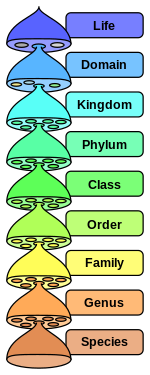
Binomial Nomenclature - A shorthand was to identify plants by using the genus and species for that whole system of classification. Click for more about biological classification.


How does a plant get its name?

1) Find the plant.
2) Describe it.
3) Search literature to see if it is already named and decribed.
4) Examine Herbarium specimens to see if it has been named.
5) Deposit a "type specimen" in an Herbarium.
6) Publish findings.


Next class will consist of a little more information on diversity and then a section test. After that, it's back to the gardens!

Tuesday, November 3, 2009

Week 9 - Botany 1: Intro to Botany Class (part c)

Time in: 9am
Time out: 12pm

This week, we learned about sexual and asexual reproduction of plants. We also learned about flower parts. We also learned about the difference between a seed and a spore.

A seed generally comes from a flower-producing plant. It is a complete capsule, equipped with food that can wait for the right moment to germinate. A date palm seed, for example, was discovered in Israel sometime in 2008 and has been carbon-dated to be 2000 year old! Check out this article entitled "Jesus-era seed seed is the oldest to germinate" from the New Scientist magazine.

A spore is what a non-flowering plant would use to germinate. Spores are usually single cells that are not capable of holding its own food, has no embryo and is dependent on water for germination. Examples of a spore are those dots on the back of a fern. Moss, algae and mushrooms also come from spores.


We then took a test that will move us to the second section of Botany Classes.

I must admit, as much as I enjoy and appreciate learning all of this information, I'm itching to get back to the Herb garden!

Tuesday, October 27, 2009

Week 8 - Botany 1: Intro to Botany Class (part b)


Time in: 9am
Time out: 12am

Plant Processes


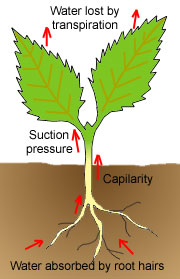
Seeds swell when dampened which breaks its dormant state. Roots come out and create root hairs which is the primary source for the uptake of water.

2 basic hormones a plant has are auxins and gibberellins.

Auxins are produced in the apical meristem. It controls lengthening of the stem and also inhibits lateral bud growth. Apical dominance can be controlled by removing the tip

Giberellins control internode elongation, dormancy, flowering and other processes.

Photosynthesis is the process by which plants capture the energy of the sun and convert it to chemical energy. This process generally happens in leaves.

6CO2 + 6H2O + energy = C6H12O6 + 6O2
(Carbon Dioxide + water + sun = sucrose + oxygen )


Respiration is the process by which cells release stored energy for uses.

C6H12O6 + 6O2 = 6CO2 + 6H2O + energy
(stored food + oxygen = water vapor + stored energy)


Transpiration is the process of movement of water through the roots, stems and leaves.


Tuesday, October 20, 2009

Week 7 Botany 1: Introduction to Botany (part a)

Time in: 9am
Time out: 12:15pm

Today was the first official class for Botany 1 at the Huntington. We went over a brief analysis of the terms, general functions and types of diversity that consist in plant cells, plant tissues and plant organs. Here are just a few highlights:

Plant cells:

The primary cell wall, which is the outside structure of the cell, holds all the needed living organisms of the cell inside. It is used for protection and is made of cellulose.

The vacuole (the clear, bubble-shaped looking structures within the plastic cell model) are frequently filled with water and keeps the cell plump, also known as turgor pressure.

The nucleus (the yellow oval inside the cell model) is the DNA of the plant cell.


Plant tissues:

Apical (or primary) meristems leads to elongation of the plant. This is also where new cells form and are rapidly dividing.

Lateral (or secondary) meristems creates the width of the plant. This can lead to thickening in stems and roots. It helps to create wood.


Plant organs:

The three main organs of the plant are its roots, stems and leaves.

The root hairs grow out of the epidermis and is responsible for taking in water. Root hairs develop within a day of germination.

The root cap simply protects the very tip of the roots.

Roots absorb water and dissolved minerals, store food and water, and anchor the plant.


Next week, we will continue our talk about plant organs, discuss the functions and diversity of stems and leaves, and move on to plant processes.