Tuesday, October 27, 2009

Week 8 - Botany 1: Intro to Botany Class (part b)


Time in: 9am
Time out: 12am

Plant Processes


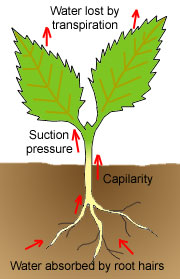
Seeds swell when dampened which breaks its dormant state. Roots come out and create root hairs which is the primary source for the uptake of water.

2 basic hormones a plant has are auxins and gibberellins.

Auxins are produced in the apical meristem. It controls lengthening of the stem and also inhibits lateral bud growth. Apical dominance can be controlled by removing the tip

Giberellins control internode elongation, dormancy, flowering and other processes.

Photosynthesis is the process by which plants capture the energy of the sun and convert it to chemical energy. This process generally happens in leaves.

6CO2 + 6H2O + energy = C6H12O6 + 6O2
(Carbon Dioxide + water + sun = sucrose + oxygen )


Respiration is the process by which cells release stored energy for uses.

C6H12O6 + 6O2 = 6CO2 + 6H2O + energy
(stored food + oxygen = water vapor + stored energy)


Transpiration is the process of movement of water through the roots, stems and leaves.


Sunday, October 25, 2009

Plant Progress - Oct. 25th


These green-manure plants are growing so fast that I'm considering a second allotment of them. Especially the cereal rye since the directions suggest that I wait no longer than 12 inches in height before I till them into the soil. It's fun to see the almost immediate changes every week.


Aquadulce Fava Bean


Braco Mustard


Cereal Rye


Crimson Clover

Saturday, October 24, 2009

Week 7 Arroyo Seco Park

Alnus rhombifolia
(A tall White Alder growing under the historic
Colorado Street Bridge in Pasadena)


Time in: 9am
Time out: 12pm

This was my first visit to the Arroyo Seco Park, the largest park in the South Pasadena area, and I was thoroughly impressed. The CNPS native plant walk was led by two very knowledgeable and organized women. One of them focused on the scientific and European practices of each plant while the other chimed in with her knowledge of Native American uses. They did a wonderfully thorough job and it was clear they enjoyed sharing their knowledge with us.

Here are just some highlights of what must have been around 40+ species of plants we were introduced to:

Rosa canina
(Rose hips)


Datura stramonium
(Jimson weed)


Cucurbita palmata
(Coyote Gourd)


Stellaria spp.
(Chickweed)


Claytonia perfoliata
(Miner's Lettuce)


Ribes aureum
(Golden currant)


Rubus ursinus
(California blackberry)


Acacia baileyana
(Bailey's acacia)

Tuesday, October 20, 2009

Week 7 Botany 1: Introduction to Botany (part a)

Time in: 9am
Time out: 12:15pm

Today was the first official class for Botany 1 at the Huntington. We went over a brief analysis of the terms, general functions and types of diversity that consist in plant cells, plant tissues and plant organs. Here are just a few highlights:

Plant cells:

The primary cell wall, which is the outside structure of the cell, holds all the needed living organisms of the cell inside. It is used for protection and is made of cellulose.

The vacuole (the clear, bubble-shaped looking structures within the plastic cell model) are frequently filled with water and keeps the cell plump, also known as turgor pressure.

The nucleus (the yellow oval inside the cell model) is the DNA of the plant cell.


Plant tissues:

Apical (or primary) meristems leads to elongation of the plant. This is also where new cells form and are rapidly dividing.

Lateral (or secondary) meristems creates the width of the plant. This can lead to thickening in stems and roots. It helps to create wood.


Plant organs:

The three main organs of the plant are its roots, stems and leaves.

The root hairs grow out of the epidermis and is responsible for taking in water. Root hairs develop within a day of germination.

The root cap simply protects the very tip of the roots.

Roots absorb water and dissolved minerals, store food and water, and anchor the plant.


Next week, we will continue our talk about plant organs, discuss the functions and diversity of stems and leaves, and move on to plant processes.

Monday, October 19, 2009

Plant Progress - Oct 17th


The green manure plants are looking healthy and vigorous. They survived the two day rains and the 90 degree heat that immediately followed. The Fava beans have also come up!


Aquadulce Fava Beans


Braco Mustard


Cereal Rye


Crimson Clover


There were a few holes in the Crimson Clover patch, which I suspect are squirrels, so I decided to lay down some chili pepper flakes - a trick I learned from last spring's tomato patch project.


And while I was doing that, Jared planted some winter veggies in the newly mulched narrow plots. We decided on broccoli, beets, lettuce and spinach. Sounds like a nice winter stew!

Friday, October 16, 2009

Plant Progress - Oct. 5th

I planted the seeds on Monday, October 5th and by Saturday, October 10th, they started sprouting! It's always exciting to see the first sprouts come up.


Braco Mustard


Cereal Rye


Crimson Clover


The Aquadulce Fava Beans have yet to come up. It has been about 5 days since I have visited the plot and two of them were pretty rainy. Of course now they are saying the teperature will climb back into the 90's. I will be checking in on everything today and because of the quick weather changes we've been experiencing, I'm a little anxious. they only just started sprouting so I hope they are making it through ok...

Tuesday, October 13, 2009

Week 6 (part 2) - Botany I Class Orientation


Time in: 9am
Time out: 12pm

In between the Conservatory and the Children's Garden there is a building called the Botanical Auditorium. Among many other events (including the annual orchid show that will be held this weekend), this is were the Huntington's Botany classes for interested volunteers take place. These classes are given primarily for those who wish to become docents.

Today was a day to acquaint ourselves with this building, our teachers and our fellow classmates. The lower floor consists of an auditorium (where our classes are held), a volunteer room, offices and a botanical library. the upper floor consists of more offices and classrooms. We were introduced to a very knowledgeable staff who invited us to ask them questions whenever we felt the need.

Botany classes are divided into 3 sections with 2 classes per section. The first section (Botany 1) is called Introduction to Botany. The second section (Botany 2) is called Plant Diversity. The third section (Botany 3) is an optional course (some of the gardens requires it, such as the cactus department, others do not) and is called Plant Adaptation. After these courses, volunteers then take another set of classes that are specifically required for their field. Currently, they are only offering courses in the camellia, rose and desert gardens because these gardens are the most in need of volunteers at this time.

Everyone I met so far is friendly, helpful and interested, which will make for a good time in class!

Here's a picture of the orange orchard located right next to the Botanical Auditorium. These orange trees are the original trees that have been here since Mr. Huntington bought the property.